


Wade Lightheart
President


One common misconception about magnesium is believing you simply need more of it to support your well-being.
In reality, magnesium comes in multiple forms, and each form is designed to support absorption, delivery, and tolerability in different ways throughout the body.
Most people—even those who consider themselves healthy—typically consume only one or two forms of magnesium, often in amounts that may not fully meet the body's needs.

Commonly chosen for relaxation, restful sleep, and muscle support thanks to its gentle, highly absorbable form*.

Often used to support healthy energy production and daily magnesium replenishment with a highly absorbable form of magnesium*.

Commonly used in heart-focused wellness formulas to support cardiovascular health and healthy circulation*.

Chosen for its highly absorbable form to help support muscle function and everyday performance*.

Often included in active lifestyle formulas to support energy production, recovery, and performance*.

Commonly used to support daily energy and healthy muscle function with a well-absorbed form of magnesium*.

Features an advanced delivery system designed to support enhanced magnesium absorption and uptake*.
Commonly chosen for relaxation, restful sleep, and muscle support thanks to its gentle, highly absorbable form*.
Often used to support healthy energy production and daily magnesium replenishment with a highly absorbable form of magnesium*.
Commonly used in heart-focused wellness formulas to support cardiovascular health and healthy circulation*.
Chosen for its highly absorbable form to help support muscle function and everyday performance*.
Often included in active lifestyle formulas to support energy production, recovery, and performance*.
Commonly used to support daily energy and healthy muscle function with a well-absorbed form of magnesium*.
Features an advanced delivery system designed to support enhanced magnesium absorption and uptake*.






Magnesium may be important in maintaining heart health and blood vessel health*. Low magnesium levels may contribute to blood vessel constriction, blood clotting, and stress responses associated with cardiovascular stress.
A magnesium supplement significantly supported a healthy stress response in people who are low in magnesium. Also, when combined with vitamin B6, magnesium was found to be 40% more helpful than magnesium alone in very stressful situations. Findings support the need for magnesium supplementation for people living in conditions of ongoing stress.
A magnesium supplement significantly improved mood after 2 weeks. Another trial found that magnesium supplements improved mood in seniors.
Magnesium is important for healthy glucose metabolism and research suggests some people with metabolic health concerns may have lower magnesium status. Even when blood sugar is normal, a supplement may still help support healthy magnesium levels. In a clinical trial, magnesium supplementation supported healthy metabolic function and glucose metabolism.
A large-scale systematic and dose-response analysis found that magnesium supplementation was associated with reductions in body weight and waist circumference among specific groups of people. Participants who supplemented with magnesium tended to have lower body weight and smaller waist circumference measurements.
Magnesium on its own doesn't cure blood sugar problems or cause weight loss, but it can be highly beneficial in combination with diet and exercise.
Magnesium supplementation may help support exercise performance, muscle function, and recovery,possibly by supporting healthy energy metabolism. It also helps support the body’s response to exercise and exercise-related muscle stress.
In a small clinical trial involving 46 older adults with sleep concerns,daily magnesium supplementation was associated with improvements in sleep quality, sleep latency, and cortisol levels. Participants also showed higher melatonin levels and reported fewer nighttime awakenings.
Magnesium is a key building block of your bones.Low magnesium status may negatively affect bone health and healthy bone maintenance by:
A meta-analysis of 34 randomized controlled trials found that magnesium supported healthy blood pressure already within the normal range.
However, the effect size is clinically small (<2 mmHg). Therefore, it may be good for supporting overall health and healthy blood pressure, but you may also need other support to achieve healthy blood pressure levels.
Low magnesium status may affect healthy immune function and inflammatory balance.In a meta-analysis involving 32,198 people, those with higher magnesium intake had lower serum C-reactive protein levels (a marker associated with inflammation).
Overall, healthy magnesium levels may help support balanced inflammatory and immune responses.
Both Vitamin D and magnesium have important roles in bone health, immune function, and metabolism. Magnesium is a cofactor in vitamin D conversion and activation.Some people cannot increase their blood 25-hydroxy vitamin D levels despite supplementing with vitamin D3 because they are low in magnesium. In other words, low magnesium status can make vitamin D less effective.
Also, in people with low magnesium levels, high doses of vitamin D3 may further reduce magnesium levels and affect how the body balances calcium and magnesium.*
President

Chief Executive Officer


CEO/Co-founder of BIOptimizers
Vitamin B6 helps support magnesium utilization and absorption*. A clinical study compared the effects of magnesium with magnesium combined with B6. In the study, participants experiencing higher stress levels reported greater improvements in stress-related scores when magnesium was combined with vitamin B6 compared to magnesium alone. The vitamin B6 in this product is provided as Pyridoxal-5-Phosphate (P5P), the active form of vitamin B6, because it does not require conversion by the body before use and helps support magnesium utilization and bioavailability*.
Not all magnesium supplements are created equal, as different forms of magnesium may vary in absorption and formulation characteristics.
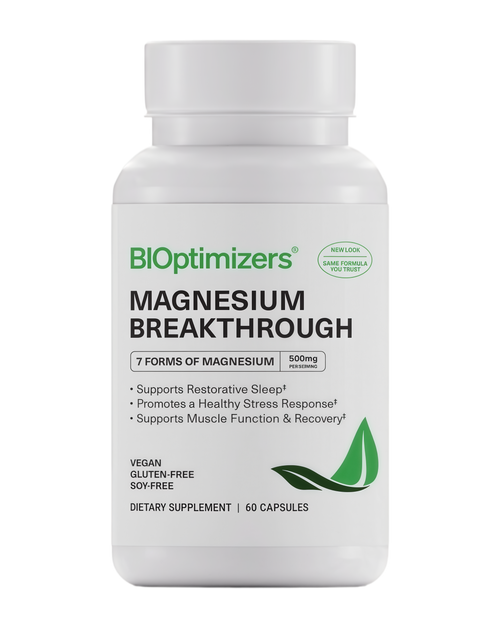
Magnesium Breakthrough® combines seven forms of magnesium in one comprehensive formula designed to support whole-body wellness and magnesium replenishment*.
For pregnant women, the German Nutrition Society recommends a daily magnesium intake of 310 mg (slightly above the recommended amount for non-pregnant women over the age of 25). Hormonal changes during pregnancy may influence magnesium needs and utilization.
Please note that Magnesium Breakthrough is not specifically formulated or tested for pregnant women. It’s best to consult your OB/GYN or healthcare practitioner before introducing any supplements during pregnancy.
Magnesium Breakthrough is best taken consistently as part of your daily routine. Some people prefer taking it on an empty stomach, while others may prefer taking it with food for better digestive comfort. The recommended daily serving is 500 mg of elemental magnesium (2 capsules) for general wellness support*.
Some people choose to gradually increase their intake based on personal preference and tolerance. However, higher intake levels should be approached cautiously and ideally discussed with a healthcare practitioner. You can take Magnesium Breakthrough at any time of day that works best for your routine. Some people prefer taking it in the morning as part of their daily wellness routine, while others take it in the evening to support relaxation and restful sleep*.
These foods can be good dietary sources of magnesium, especially when grown in mineral-rich soil. However, modern agricultural practices may affect magnesium levels in some soils and foods.